PRAGMATRADING.COM1P R A G M A R E S E A R C H NOTE
Traders on both the buy-side and sell-side focus
much attention and energy on trading venues and
order types. There is a notion, implicitly encouraged
by many trading venues, that best execution can be
achieved through venue curation—routing to good
venues and shunning bad ones. But the reality is more
complex: venues offer tradeoffs, and best execution
can only be achieved by using venues and order types
selectively and intelligently, based on stock character-
istics, order characteristics, and dynamic signals.
In competing for order flow, trading venues tend
toward simplistic marketing claims to imply that
their venue or order type is better than others.
Displayed venues often tout their volumes and fill
rates. Dark venues and hidden or discretionary
order type pitches often focus on fill quality, usually
measured by markout. Block-oriented venues talk
NO. 26 | OCTOBER 202 1
On the Limits of Markouts
and Venue Curation
about trade size. The reality is that venues and
order types offer tradeoffs between execution
quality and fill rate. There is no best venue or
order type that should be used across all stock
characteristics, trading goals, and market conditions.
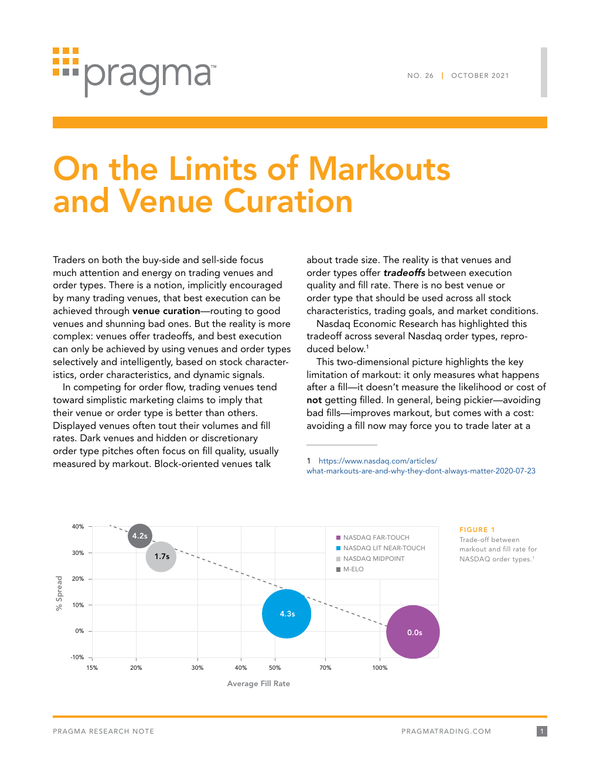
Nasdaq Economic Research has highlighted this
tradeoff across several Nasdaq order types, repro-
duced below.1
This two-dimensional picture highlights the key
limitation of markout: it only measures what happens
after a fill—it doesn’t measure the likelihood or cost of
not getting filled. In general, being pickier—avoiding
bad fills—improves markout, but comes with a cost:
avoiding a fill now may force you to trade later at a
1 https://www.nasdaq.com/articles/
what-markouts-are-and-why-they-dont-always-matter-2020-07-23
15% 20% 30% 40% 50% 70% 100%
-10%
0%
10%
20%
30%
40%
Average Fill Rate
% Spread
4.2s
1.7s
4.3s
0.0s
NASDAQ FAR-TOUCH
NASDAQ LIT NEAR-TOUCH
NASDAQ MIDPOINT
M-ELO
FIGURE 1
Trade-off between
markout and fill rate for
NASDAQ order types.1
Traders on both the buy-side and sell-side focus
much attention and energy on trading venues and
order types. There is a notion, implicitly encouraged
by many trading venues, that best execution can be
achieved through venue curation—routing to good
venues and shunning bad ones. But the reality is more
complex: venues offer tradeoffs, and best execution
can only be achieved by using venues and order types
selectively and intelligently, based on stock character-
istics, order characteristics, and dynamic signals.
In competing for order flow, trading venues tend
toward simplistic marketing claims to imply that
their venue or order type is better than others.
Displayed venues often tout their volumes and fill
rates. Dark venues and hidden or discretionary
order type pitches often focus on fill quality, usually
measured by markout. Block-oriented venues talk
NO. 26 | OCTOBER 202 1
On the Limits of Markouts
and Venue Curation
about trade size. The reality is that venues and
order types offer tradeoffs between execution
quality and fill rate. There is no best venue or
order type that should be used across all stock
characteristics, trading goals, and market conditions.
Nasdaq Economic Research has highlighted this
tradeoff across several Nasdaq order types, repro-
duced below.1
This two-dimensional picture highlights the key
limitation of markout: it only measures what happens
after a fill—it doesn’t measure the likelihood or cost of
not getting filled. In general, being pickier—avoiding
bad fills—improves markout, but comes with a cost:
avoiding a fill now may force you to trade later at a
1 https://www.nasdaq.com/articles/
what-markouts-are-and-why-they-dont-always-matter-2020-07-23
15% 20% 30% 40% 50% 70% 100%
-10%
0%
10%
20%
30%
40%
Average Fill Rate
% Spread
4.2s
1.7s
4.3s
0.0s
NASDAQ FAR-TOUCH
NASDAQ LIT NEAR-TOUCH
NASDAQ MIDPOINT
M-ELO
FIGURE 1
Trade-off between
markout and fill rate for
NASDAQ order types.1
PRAGMATRADING.COM2O C T O B E R 2 0 2 1
worse price—whether to stay on a VWAP schedule
dictated by the trader, or just to eventually complete
the order. This isn’t rocket science—most traders are
familiar with these tradeoffs in the context of using
optimistic limit prices, where the benefit of holding
out for a better price has to be weighed against the
risk you might “miss the market.”
It’s generally the balance of these two competing
effects, and whether they match the specific trading
situation, that determine whether a venue or tactic is
good or bad. Using a picky order type when trading
an urgent order can degrade performance. Simple use
of markout does not show this obvious fact.
A Markout Case Study:
IEX D-Limit
Last fall IEX introduced the D-Limit order type, con-
tinuing their track record of innovation. Simply put,
D-Limit orders are designed to pull from the market
and avoid execution when it looks like the market is
likely to trade through them. This is a reasonable idea:
avoiding being run over is generally a good thing. IEX
posted a blog highlighting this benefit by showing
that D-Limit orders have better markout than other
venues’ ordinary passive orders.2
This is fine as far as it goes, but common sense tells
us that IEX’s D-Limit might come at some opportunity
cost in missed liquidity—not just because of the order
pulling, but also because IEX as a venue only repre-
sents about 3% of market volume, most of it at mid-
point, and without the large rebate to attract takers as
2 https://medium.com/boxes-and-lines/d-limit-one-of-these-
things-is-not-like-the-others-3c6b438d3a6e
some inverted venues have. If those opportunity costs
are too high, use of this “smart” order type could hurt
performance.
IEX followed up with another blog to answer this ques-
tion, as they put it “are D-Limit’s performance and price
improvement worth its lower fill rate?”3 Unfortunately
there were two big limitations in their analysis.
The first problem is that D-Limit was compared not
against posting a limit order on say Nasdaq or NYSE,
but posting a standard limit order on IEX. This leaves
the possibility that while IEX D-Limit is preferable to
a regular IEX limit order, it is still inferior to options
available on other venues with a higher probability
of fill. This is a serious problem because the market
running away before you get filled is exactly the kind
of opportunity cost you should worry about when
posting a picky order on a small venue.
The second problem is the analysis looked only at
D-Limit orders that were pulled and where the market
then didn’t tick up above the original limit price within a
second. But this leaves out many possible bad outcomes
of posting an order, including all the cases where the
order wasn’t executed and the market ticked away to
above the original posting price. A proper accounting
of the cost of any trading tactic must be a probability-
weighted average of all the possible outcomes—the bad
as well as the good. IEX presumably reasoned that such
bad outcomes would be equal between regular IEX
and IEX D-Limit orders—but this returns us to the first
problem: how many bad outcomes are there when post-
ing IEX D-Limit vs. say posting a regular limit order on
Nasdaq, and how do these weigh against the benefits?
3 https://medium.com/boxes-and-lines/d-limit-performance-the-
fill-rates-race-4dcd26661a98
10 20 30 40 50
Fill Rate (%)
40
30
50
Markout – % Spread
IEX D-LIMIT
IEX
STANDARD
INVERTED
BETTER PERFORMANCE
FIGURE 2
Markout and Fill Rate of
Near-Touch Limit Orders
Markout and fill rate of IEX regular limit and
IEX D-Limit vs. regular limit orders on two
of the largest maker-taker (Standard) and
taker-maker (Inverted) exchanges. Markouts
are measured 1 second after execution relative
to the far touch and include fees. D-Limit
appears to have better markout but lower
probability of fill. This doesn’t tell us anything
definitive about D-Limit, but illustrates
the first problem with the IEX analysis.
worse price—whether to stay on a VWAP schedule
dictated by the trader, or just to eventually complete
the order. This isn’t rocket science—most traders are
familiar with these tradeoffs in the context of using
optimistic limit prices, where the benefit of holding
out for a better price has to be weighed against the
risk you might “miss the market.”
It’s generally the balance of these two competing
effects, and whether they match the specific trading
situation, that determine whether a venue or tactic is
good or bad. Using a picky order type when trading
an urgent order can degrade performance. Simple use
of markout does not show this obvious fact.
A Markout Case Study:
IEX D-Limit
Last fall IEX introduced the D-Limit order type, con-
tinuing their track record of innovation. Simply put,
D-Limit orders are designed to pull from the market
and avoid execution when it looks like the market is
likely to trade through them. This is a reasonable idea:
avoiding being run over is generally a good thing. IEX
posted a blog highlighting this benefit by showing
that D-Limit orders have better markout than other
venues’ ordinary passive orders.2
This is fine as far as it goes, but common sense tells
us that IEX’s D-Limit might come at some opportunity
cost in missed liquidity—not just because of the order
pulling, but also because IEX as a venue only repre-
sents about 3% of market volume, most of it at mid-
point, and without the large rebate to attract takers as
2 https://medium.com/boxes-and-lines/d-limit-one-of-these-
things-is-not-like-the-others-3c6b438d3a6e
some inverted venues have. If those opportunity costs
are too high, use of this “smart” order type could hurt
performance.
IEX followed up with another blog to answer this ques-
tion, as they put it “are D-Limit’s performance and price
improvement worth its lower fill rate?”3 Unfortunately
there were two big limitations in their analysis.
The first problem is that D-Limit was compared not
against posting a limit order on say Nasdaq or NYSE,
but posting a standard limit order on IEX. This leaves
the possibility that while IEX D-Limit is preferable to
a regular IEX limit order, it is still inferior to options
available on other venues with a higher probability
of fill. This is a serious problem because the market
running away before you get filled is exactly the kind
of opportunity cost you should worry about when
posting a picky order on a small venue.
The second problem is the analysis looked only at
D-Limit orders that were pulled and where the market
then didn’t tick up above the original limit price within a
second. But this leaves out many possible bad outcomes
of posting an order, including all the cases where the
order wasn’t executed and the market ticked away to
above the original posting price. A proper accounting
of the cost of any trading tactic must be a probability-
weighted average of all the possible outcomes—the bad
as well as the good. IEX presumably reasoned that such
bad outcomes would be equal between regular IEX
and IEX D-Limit orders—but this returns us to the first
problem: how many bad outcomes are there when post-
ing IEX D-Limit vs. say posting a regular limit order on
Nasdaq, and how do these weigh against the benefits?
3 https://medium.com/boxes-and-lines/d-limit-performance-the-
fill-rates-race-4dcd26661a98
10 20 30 40 50
Fill Rate (%)
40
30
50
Markout – % Spread
IEX D-LIMIT
IEX
STANDARD
INVERTED
BETTER PERFORMANCE
FIGURE 2
Markout and Fill Rate of
Near-Touch Limit Orders
Markout and fill rate of IEX regular limit and
IEX D-Limit vs. regular limit orders on two
of the largest maker-taker (Standard) and
taker-maker (Inverted) exchanges. Markouts
are measured 1 second after execution relative
to the far touch and include fees. D-Limit
appears to have better markout but lower
probability of fill. This doesn’t tell us anything
definitive about D-Limit, but illustrates
the first problem with the IEX analysis.